LPGA’s Japanese Golfers Helping Raise Money And Hope

Ai Miyazato, Mika Miyazato (no relation) and Momoko Ueda are Japanese natives playing golf this week at the LPGA Kia Classic at the Industry Hills Golf Club in the City of Industry. They have a job to do, playing golf, and so they are trying to keep their attention focused on the course even as they check the Internet constantly for news from home about earthquakes and the tsunami.

Ai Miyazato went to high school near Sendai, the Japanese city hit hardest by the tsunami. Ueda said she was in Tokyo on a freeway. “I literally felt the ground shake,” she said. Mika Miyazato said that as she saw the tragedies unfold she wanted to do something for the country and discussed with Ai  Miyazato and Ueda what they could do.

The three helped design a special logo that is on their golf hats. It is in Japanese and Ai Miyazato said it means “Never give up.” There is also a Facebook page, and the three are asking other players to put the special logo on caps.

Please click here for the full article.

Match Play Will Remain In Arizona In 2012

The PGA Tour announced Monday that the World Golf Championships – Accenture Match Play Championship will be played at Dove Mountain again in 2012.

There had been rumors the event was going to move, but the PGA Tour, along with the International Federation of PGA Tour, have agreed to keep the event at the Ritz-Carlton Golf Club at Dove Mountain.

“We’re pleased to announce the extension of our partnership with The Ritz- Carlton, Dove Mountain for the 2012 Accenture Match Play Championship,” said David Pillsbury, Executive Vice President, Championship Management. “The community of Tucson has supported professional golf for decades, and we’ve enjoyed five years of exciting, match-play golf since the Accenture Match Play Championship moved to Marana in 2007.

“I’d like to thank Accenture for its continued support as title sponsor of the event and as Umbrella Sponsor of the World Golf Championships. We look forward to another successful Accenture Match Play Championship in 2012 when Luke Donald returns to defend his title.”

Donald took down Martin Kaymer, 3 & 2, in this year’s Match Play Championship. Despite the loss, Kaymer moved to No. 1 in the world rankings.

Next year’s Match Play will take place from February 22-26.

Read more: http://www.miamiherald.com/2011/03/21/2126481/match-play-will-remain-in-arizona.html#ixzz1HKnlfoNi

Keeping Fit Will Benefit Your Golf Performance

I just read this great article on how keeping fit will help your golf game – here it is and I hope you enjoy reading it too…


A Beginners Guide To Golf Equipment – Part One

In my last blog post I covered the basic rules and etiquette of golf.

In the post I’m going to cover how and when to use which clubs, starting with woods and the long irons.

Golf clubs have come a long way in recent years in terms of design, build and the technology applied to their development.

Back when the game was first invented, in the 1500’s,  a set of clubs would generally feature a ‘longnose’ for driving, a ‘fairway club’ for mid range shots, a ‘spoon’ for shorter shots and the famous niblick for around the green. The putter back then was known as a ‘cleek’. The shafts of the clubs were generally made from hickory.

Steel shafts came into fashion in the 1920’s, before in the 1980’s more technologically advanced materials such as graphite and titanium became very popular – not least because of their weight – considerably lighter than steel and therefore easier to swing (and carry around!).

Although as you would expect, clubs are far more advanced than they have ever been, the general idea behind each club hasn’t changed much at all since the invention of the game.

The rules today state that you can have 14 clubs in your bag for the round.

So let’s take a look at each of those clubs, starting with the driver.

The driver is used almost always off the tee and is the club you use to obtain as much distance as possible. A typical use of the driver is on a Par 4 or Par 5 whole, where the first shot needs to travel as far as possible to give you more control when using a more lofted club for your next shot towards the green.

In terms of actual length, the driver will be the longest club in your bag, and the least lofted – ie the angle of the face of the club will be steeper than any of your other clubs (typically between 7 and 12 degrees).

It will probably be the most expensive club that you purchase – drivers can cost from £30 to over £500 for a top brand such as Callaway or Taylor Made.

Driver

 
The driver is a tough club to master using, and the margin for error can be small for even the most experienced golfer. Therefore many beginners and intermediate players may prefer to use a 3 wood or 5 wood off the tee to start with.

These clubs are more ‘forgiving’, are shorter in length and have greater loft so the ball stands more chance of going higher when you hit it. You can also use one of these clubs of the fairway with a good lie, giving you more power than using an iron. There is also a 7-wood, although this is used less frequently by the average golfer.

Although these clubs are referred to as ‘woods’, you won’t find many made of actual wood these days – they are almost always made of metallic material such as titanium or steel.

Now we move onto the irons, which are numbered from 1-9 according to the angle of the face – the lower the number the steeper the face. And the steeper the face, the more difficult the club is to hit.

The 1 iron is known to all golfers as the most difficult club to use. American Golfer Lee Trevino once said:

“If you are caught on a golf course during a storm and are afraid of lightning, hold up a 1 iron. Not even God can hit a 1 iron”

I wouldn’t recommend the use of a 1 iron or 2 iron for beginners or intermediate players – I would say that using a 3 wood or 5 wood represents a better option for you at this stage.

Finally for this post, let’s take a look at the 3 iron – the longest iron in a standard modern set of clubs. To be honest, it’s still not the easiest club to hit but is the easiest of the long irons at least, and perhaps worth a go off the tee on a long par 3.  Most modern irons have what’s known as a ‘cavity back’. This means that the back of the club has been hollowed-out, as opposed to just a block of metal. This creates a larger ‘sweet-spot’ which means that there is more chance of hitting the ball cleanly and further.

I’ll talk about this more next week, along with an introduction to the mid-irons and wedges.

If you have any questions in the meantime, please drop me a line by clicking here.


Tiger Confident He Can Break Nicklaus Record

Tiger Woods still thinks he can break Jack Nicklaus’ record of 18 Major golf championships, telling CNBC in an interview during the annual Tavistock Cup, that his game is coming around.

“I know I can do it,” said Woods. “I just need to put all the pieces together and get it done.”

So far, Woods has won 14 Majors and 95 titles around the world, including 71 on the PGA Tour. But he hasn’t captured an event in 16 months. The 35-year-old golf legend is undergoing a swing change with new coach Sean Foley, and told CNBC, he’s searching for more consistency.

Please click here to read the full article.


Ishikawa Faces Mixed Emotions

Japan’s biggest golfing star Ryo Ishikawa will face a tough couple of weeks, currently in the middle of a three-tournament stretch at the Transitions Championship and scheduled to be in America through the Masters.

Ishikawa  grew up northwest of Tokyo, some 300 miles from the Miyagi prefecture that was hardest hit by the recent earthquake and tsunami.

His family is safe and he is in contact with them, but while his head will try and remain focused on golf, his heart is in his homeland, which now faces concerns over a potential nuclear meltdown.


Golf’s Generation Gap Closes

While waiting for the Phil Mickelson and Tiger Woods we remember to return – a wait with no guarantees – golf has gone young. Not ‘Justin Bieber’  young but new generation young.

It has happened through the years just as reliably as people sneezing in springtime. There was the Crenshaw-Kite-Wadkins era. The Faldo-Langer-Olazabal era. The Woods-Mickelson-Els era.

Please click here to read the full article.

Nick Watney wins WGC Cadillac Championship at Doral

Nick Watney overhauled fellow American Dustin Johnson to win the WGC Cadillac Championship in Florida.

Watney birdied the 18th for a five-under 67 to end 16 under and go one better than his runner-up spot in 2009.

Overnight leader Johnson (71) ended 14 under with Dane Anders Hansen and Italy’s Francesco Molinari 13 under.

England’s Luke Donald, tied second overnight, could only manage a level-par 72 for 11 under, while Tiger Woods shot 66 to end 10th at eight under.

Please click here to read the full article.


The Basic Rules Of Golf

Learning to play golf is not just about picking up a club and hitting a ball – far from it. Of course fundamentally that’s the physical aspect of the game, using one of a variety of clubs to hit a ball into a hole a few hundred yards away, but there are also rules and ettiquette to follow too.

The beauty of golf is that although you can play against one, two or three other people at once, you are also all playing against the course, and so every course you play on adds a totally different dimension to every game of golf that you play.

A standard golf course is made up of 18 holes (although Dukes Meadows Golf Club, where I am based, is a challenging nine-hole course, although you can always go round twice!). The first shot on each hole is usually hit from a tee, in an area where different markers indicate whereabouts you should hit the ball from. There are separate markers for gents, ladies, and also professionals.

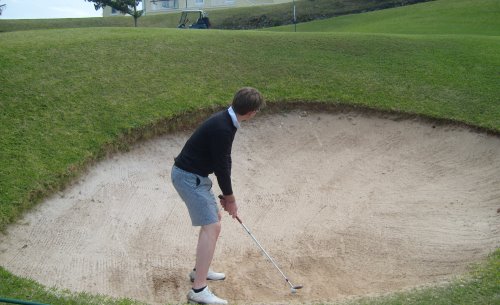
The course will more than likely be covered in hazards which you will need to try and avoid hitting – for example bunkers, rough or longer grass, and the dreaded water. The place you want to be is the fairway – closely-mown grass that usually runs length-ways down the centre of the hole that you’re playing.
James Irons Golf

Try And Stay Out Of The Bunker!

The hole itself will be on the green – a section of even more closely-mown grass  – where you will look to putt the ball home. You can see the hole from a distance represented by a flag with the number of the hole usually written on it. The flags are usually yellow or red.

So your aim is to get from the tee to the hole in as few shots as possible – the combined total of shots that you take makes up your total score, and so if you take less shots than your opponent, you win the game – simple!

There are a number of golfing terms regarding scoring that even if you’re not familiar with playing golf, you probably would have heard of. These usually refer to the number of shots you have taken on each hole either side of the par for the hole. Holes are usually par 3, 4 or 5 – these are based on a combination of difficulty and length, and you are aiming to take a minimum of that number of shots per hole. The par for the course is the par for each hole multiplied by the number of holes on the course.

If you take one shot less than the par of the hole to get your ball down, this is called a birdie. If you take one shot more than the par of the hole, this is called a bogey. Please see a full list of these terms below.

Albatross: Three shots less than par
Eagle: Two shots less less than par
Birdie: One shot less less than par
Bogey: One shot more than par
Double bogey: Two shots more than par
Triple bogey: Three shots more than par

At the end of the game, your total score is balanced against the par for the course. So if the par for the course is 70, and you shoot 68, you are 2 under-par for the round. If you shoot 80, you are ten over par. When playing enough times, you will eventually gain a handicap – effectively the average number of shots you take to go around above par. This enables you to play on equal terms against the most experienced golfer.

As a professional, I don’t have a handicap at all, so if I played against someone with a ’10’ handicap, 10 shots are deducted from their overall score in order to make the competition fair for ow you were able to play against the course on the day for your ability.

Golf has a great tradition of sportsmanship, and often honesty is required in terms of admitting how many shots you have taken per hole – only in major tournaments will you find a referee or umpire.

Once the ball is in play you should not touch it with anything other than the club, and only then when taking a shot. This can be particularly tricky in the long grass or sand! If you land in the water you can choose a new ball and take a ‘drop’ in line with where the ball entered the water, but no nearer the hole.

There are a lot of other rules to follow but generally what you think seems right will be right.

In terms of ettiquette – it’s best to try and remember two things: respect the course and respect your fellow golfers.

For example you should never distract a fellow player as he takes a shot, try and remember to repair the pitch and look after / rake the bunkers, and also be careful when walking across the greens – it is considered disrespectful to walk across the path that your player needs to take to putt the ball into the hole.

I hope that gives you a good idea as an introduction to the rules of golf. For more advice please contact me directly by clicking here.


 

Welcome!

Hi and welcome to my new website.

I will be posting weekly updates on this blog, from aspects of teaching to stories from the world of golf.

You can receive all of these updates into your news feeds by ‘liking’ my Facebook page at www.facebook.com/JamesIronsGolf or by following me on Twitter @JamesIronsGolf.