Tag Archives: golf tuition

Great Golf Courses | Number 1 | Wentworth (West Course)

Welcome to the first of my posts looking at the best golf courses in Britain.

To kick things off, let’s take a look at one of my favourite courses, the famous West Course at Wentworth.

There is a tremendous flow and variety to this course, with lots of elevation changes and different length par-3s, par-4s and par-5s to total a challenging Par 73.

The original design of the course, by Harry Colt in 1926, was in recent years becoming too easily challenged by the standard of today’s golfer and the golfing technology available, so with the help of Ernie Els, the course was carefully modernised, with holes lengthened and bunkers re-positioned where necessary and appropriate.

The course re-opened in 2010 following the construction of 18 brand new greens, built to USGA specifications.

Here are some Wentworth West Course Stats:

Wentworth

Opened: 1926
Architect: Harry Colt (modernised/refined between 2005 & 2010 by Ernie Els)
Par: 73
Length: 7,308 yards
Course Record: 62, Robert Karlsson (shot at round 3 of the BMW PGA Championship 2010)
Key tournaments: HSBC Matchplay, 1964 – 2007: BMW PGA Championship, 1984 – present day: Ryder Cup, 1953: Canada Cup 1956

Click here for a hole-by-hole guide to the course.

Click here for a fantastic course flyover (well worth a view).

Click here to view the current scorecard.

Cash Injection Boosts Northern Ireland Tour Event Hopes

Good news for fans of golf in Northern Ireland – moves to play a European Tour event at Royal Portrush were boosted after the Stormont Executive said it would provide “substantial financial backing” were such a tournament to be held.

Darren Clarke‘s Open win at Sandwich has led to renewed hopes that the major event could return to Northern Ireland for the first time since 1951.

However in the short-term, the Irish Open could move north as early as 2013.

Read more here… 

Reality TV Golf!

Now here is something I would love to see happen in the UK – a Canadian golfer is looking to kick start a sports career having won a competition on a Golf Channel reality TV show.

David Byrne beat out 11 other finalists to take home $70,000 US, an endorsement contract, and a chance to play in a PGA tour event in New Orleans on the Big Break: Indian Wells show finale Monday night.

A one metre putt decided the final against Kent Eger, another Canadian from Regina.

Sounds like a great show – please click here to read the full article – and let me know what you think – would you like to see a Reality TV Golf Show in the UK?


McIlroy Named European Tour Golfer Of The Month

Rory McIlroy’s runaway win at the US Open has made him the obvious choice for the European Tour’s Golfer of the Month award.

The 22-year-old from Holywood won his first major by eight shots with a championship record 16 under par total at the Congressional Club in Maryland.

McIlroy became the youngest winner of the title since Bobby Jones in 1923.

He returns to action in The Open at Sandwich on 14 July.

Now number four in the world, McIlroy decided to take three weeks off after his amazing victory.


McIlroy Still Dominating The Headlines

Rory McIlroy continues to dominate the sporting headlines three days after his emphatic US Open win.

There are so many great articles emerging about how he learned the game, great photos, videos and interviews that I thought I’d collate the best of them here for you to take a look at.

McIlroy has indicated that he will now take three weeks off before the Open Championship which begins at Royal St Georges on 14th July 2011.

McIlroy’s Career In Photos.

Nicklaus Tips McIlroy For Glory

The Making Of McIlroy

Bernard Gallagher: Rory Will Dominate

Can Rory Steal Tiger’s Roar?

Great Golf Apps: Number 4

Welcome to part four of my look at the greatest Golf Apps currently available.

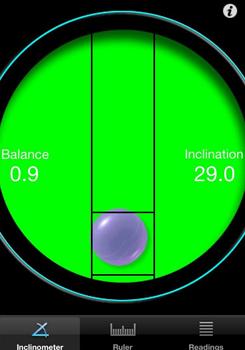
Now you can have a Stimpmeter — that angled track that releases a golf ball at a known velocity so that the distance it rolls on a green’s surface can be measured — at the touch of your fingers.

Using an accelerometer and complex algorithms to work out the stimp reading, iStimp can compare the speed of the greens on a new course with your home course to improve your putting, or use it to compare different greens on the course to check the consistency.

You also can store stimp readings to review at a later time. Compatible with iPhone, iPod touch, and iPad.


A Beginners Guide To Golf Accessories

So we’ve covered irons, woods, putters and balls – it’s now time to take a look at the various accessories on offer to golfers.

As you look around the average Pro Shop you will see that there is a huge, sometimes confusing array to choose from. There will always be fads that come and ago, but the following are essentials that will be of benefit to you when playing your first rounds of golf.

Towel
Most players carry a towel to wipe their clubs – and if you are lucky enough to be using a caddy,  they should do this after every shot for you.

Your towel clips to the side of your bag, and only needs to be small – however you may need a couple when it’s raining to keep your clubs dry.

Head Cover
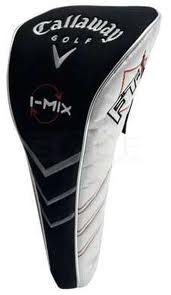
These are useful for protecting your clubs from knocks, and are mostly used on the woods. You can also buy them for irons which are useful when transporting or storing your clubs, however this can become a major pain if you’re having to constantly take them on and off your irons throughout your game! They come in various shapes and sizes, and one stage or another, everybody owns a novelty head cover, it’s kind of an unwritten rule 🙂

Pitch Fork
This is used to repair pitch marks on the green. A pitch mark occurs when the ball lands heavily on the green and creates a dent. You can use the Pitch Fork (Or Pitch Mark Repairer as they are sometimes referred to) to even these dents out and restore an even playing service to the putting green. A tee can be used instead if you don’t have one.

Marker
A marker is used only on the green, and is placed just under your ball in order that you can lift your ball off and clean it, or create room for your opponent to putt without your ball being in the way. Many golf gloves include a small pop-off marker on the wrist, otherwise you can buy plastic markers extremely cheaply, or silver / bronze markers are usually available in pro-shops in various designs. If you’re stuck you can easily use a ten-pence piece, or similar sized coin.

Pencil and scorecard
When you pay for your round in the pro-shop you will be given a scorecard, which usually acts as your proof of purchase and of course enables you to keep track of how many shots you hit on each hole.

Umbrella
It’s a sad fact that, particularly in England on Bank Holidays, it will occasionally rain during your round of golf. I would suggest an umbrella, which in most cases will keep you dry between shots. However if it’s thundering, then an umbrella (along with swinging a golf club) is not a great idea – best to head for the clubhouse on these occasions! You can also carry a set of waterproofs in your bag – these days you can get excellent lightweight waterproofs that fit easily over your existing clothing and are designed especially for golfers.

So there you go – all the accessories you need!

Did I miss anything out? Let me know, or if you have any questions, that’s what I’m hear for!

Have a great weekend 🙂


The Basic Rules Of Golf

Learning to play golf is not just about picking up a club and hitting a ball – far from it. Of course fundamentally that’s the physical aspect of the game, using one of a variety of clubs to hit a ball into a hole a few hundred yards away, but there are also rules and ettiquette to follow too.

The beauty of golf is that although you can play against one, two or three other people at once, you are also all playing against the course, and so every course you play on adds a totally different dimension to every game of golf that you play.

A standard golf course is made up of 18 holes (although Dukes Meadows Golf Club, where I am based, is a challenging nine-hole course, although you can always go round twice!). The first shot on each hole is usually hit from a tee, in an area where different markers indicate whereabouts you should hit the ball from. There are separate markers for gents, ladies, and also professionals.

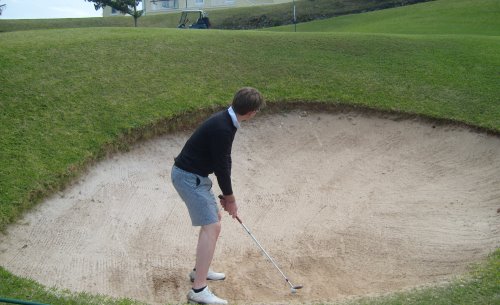
The course will more than likely be covered in hazards which you will need to try and avoid hitting – for example bunkers, rough or longer grass, and the dreaded water. The place you want to be is the fairway – closely-mown grass that usually runs length-ways down the centre of the hole that you’re playing.
James Irons Golf

Try And Stay Out Of The Bunker!

The hole itself will be on the green – a section of even more closely-mown grass  – where you will look to putt the ball home. You can see the hole from a distance represented by a flag with the number of the hole usually written on it. The flags are usually yellow or red.

So your aim is to get from the tee to the hole in as few shots as possible – the combined total of shots that you take makes up your total score, and so if you take less shots than your opponent, you win the game – simple!

There are a number of golfing terms regarding scoring that even if you’re not familiar with playing golf, you probably would have heard of. These usually refer to the number of shots you have taken on each hole either side of the par for the hole. Holes are usually par 3, 4 or 5 – these are based on a combination of difficulty and length, and you are aiming to take a minimum of that number of shots per hole. The par for the course is the par for each hole multiplied by the number of holes on the course.

If you take one shot less than the par of the hole to get your ball down, this is called a birdie. If you take one shot more than the par of the hole, this is called a bogey. Please see a full list of these terms below.

Albatross: Three shots less than par
Eagle: Two shots less less than par
Birdie: One shot less less than par
Bogey: One shot more than par
Double bogey: Two shots more than par
Triple bogey: Three shots more than par

At the end of the game, your total score is balanced against the par for the course. So if the par for the course is 70, and you shoot 68, you are 2 under-par for the round. If you shoot 80, you are ten over par. When playing enough times, you will eventually gain a handicap – effectively the average number of shots you take to go around above par. This enables you to play on equal terms against the most experienced golfer.

As a professional, I don’t have a handicap at all, so if I played against someone with a ’10’ handicap, 10 shots are deducted from their overall score in order to make the competition fair for ow you were able to play against the course on the day for your ability.

Golf has a great tradition of sportsmanship, and often honesty is required in terms of admitting how many shots you have taken per hole – only in major tournaments will you find a referee or umpire.

Once the ball is in play you should not touch it with anything other than the club, and only then when taking a shot. This can be particularly tricky in the long grass or sand! If you land in the water you can choose a new ball and take a ‘drop’ in line with where the ball entered the water, but no nearer the hole.

There are a lot of other rules to follow but generally what you think seems right will be right.

In terms of ettiquette – it’s best to try and remember two things: respect the course and respect your fellow golfers.

For example you should never distract a fellow player as he takes a shot, try and remember to repair the pitch and look after / rake the bunkers, and also be careful when walking across the greens – it is considered disrespectful to walk across the path that your player needs to take to putt the ball into the hole.

I hope that gives you a good idea as an introduction to the rules of golf. For more advice please contact me directly by clicking here.