Author Archives: mattd

Martin Laird Wins Arnold Palmer Event At Bay Hill

(From bbc.co.uk) Martin Laird defied the challenge of American Steve Marino over the final round of the Arnold Palmer Invitational at Bay Hill to win by a single shot.

The Scot squandered his two-shot overnight lead, but recovered to overtake Marino with two holes to play.

A solid approach over water at the last and a two-putt from about 80ft ensured a second PGA Tour title for Laird.

England’s Justin Rose took a share of third at six under with a round of 68 that included a five-under back nine.

Laird began the day with a decent advantage over another American Spencer Levin but bogeyed the third, seventh and ninth to reach the turn in three-over 39.

The 28-year-old slipped further off the pace as he hooked into the water following a poor tee shot for a double-bogey six on the 11th.

His resurgence began with a birdie at the 12th and, despite a further bogey on 14 to fall three shots behind, the US-based Glaswegian picked up another two strokes at the 15th and 16th to restore a two-shot lead as the charging Marino faltered.

“I’ve had perseverance all week and it paid off,” said Laird, who lost a play-off in Las Vegas last year and also lost to Matt Kuchar in a play-off for the Barclays event in August after three-putting the 72nd hole.

He added: “I don’t know if I was nervous. I thought in the morning that I’ve let a few tournaments go and I came out today, I wasn’t joking around – this was going to be my tournament to win, and I felt comfortable.

“I never thought about not winning. At three down I didn’t have a choice, I had to make birdies – Steve was playing so well and he wasn’t going to drop all the way back to where I was.

“That was the focus – not a place finish, I was out there trying to get this trophy.”

Please click here to read the full article.

A Beginners Guide To Golf Equipment – Part Two

Welcome to the second part of my Beginners Guide to Golf Equipment.

This week I’m going to talk about the mid-range irons through to the wedges.

As I explained in my last post, as the irons get higher in number, so their shafts get shorter and the club faces become more lofted. The shorter the shaft and the greater the loft, so the easier the ball is to hit.

However just hitting the ball is one thing, but to gain distance you will need to sacrifice loft, and the four and five irons provide a nice middle-ground to be able to do this.

Whereas beginners and intermediate players may struggle with a 3-iron, the 4 and 5-irons have shorter shafts and so are easier to hit, but will still guarantee you some distance if you strike the ball decently.  

Another option for a similar distance would be to use a 7 Wood. This would give you the power of hitting with a wood rather than an iron, but also sacrifices a little bit of the control that an iron gives you, particularly as your game improves and you learn to put backspin on the ball.

The first clubs that beginners are encouraged to learn with are 6 and 7-irons. This is primarily because they are in the mid-range and will give you a realistic feel of the ‘average’ golf club, and also combine the right amount of loft with the right amount of distance for a beginner to practise with, and also gain an understanding of the game with.

A good use for these clubs is also to try just half-swings or ¾ swings to vary the distance on the shots, and give you more control initially over your swing.

A 7-iron is also an ideal club to use for the ‘bump and run’ shot. This shot takes some perfecting, but is primarily used to keep the ball deliberately low – for example when there is a strong wind blowing across the course. In these conditions it may make sense to hit a ‘punchy’ 7-iron low and hard, as opposed to a lofted 8 or 9-iron which could get blown off course by the weather.

In good conditions though, the 8 and 9-irons come into their own for playing attacking shots into the green. The loft gives you the control needed to land the ball as close to the hole as possible.

As above, backspin may also be used to stop the ball from rolling forwards to far once it lands. Backspin comes from striking the back of the ball before the turf. A good tip is to keep the grooves on your iron clubs as clear from dirt as possible, as it’s these that help generate the backspin as they strike the ball. I find the using a tee works really well to do this – you can then use a towel to wipe the club face down afterwards.

Good players will also use a 9-iron from the fringe area around the green, or from longer grass, where both power and control are required.

So finally for this post, let’s take a look at the wedges, starting with the Pitching Wedge, which comes in a variety of lofts, just to confuse you!

The main aim of the pitching wedge is to play shots into the green from less than 100 yards, and the lofts will generally vary from 50 to 53 degrees – as above, the greater the loft, the more height you will generate, and the greater the control you will have.

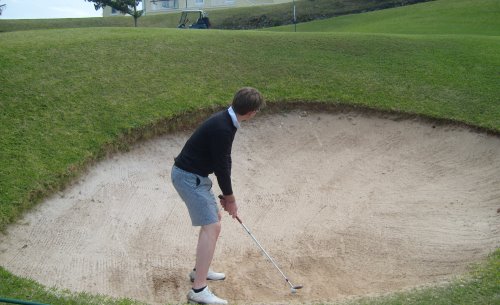
For shots even closer to the green, some players will also consider the use of a Sand Wedge.  As per its title, it is primarily designed to be used from the bunker, and is weighted along the lower edge of the blade to help with the momentum of the shot as it is played. When not being played from the sand, this wedge is also great for generating huge amounts of backspin, ideal when the hole is placed on top of a ridge, or with little room for error, but this is a shot that test even the most experienced of golfers.
James Irons Golf

The majority of professionals will also carry a Lob Wedge in their bag, for those even more precise shots close to the green. This club will have a loft of up to 60 degrees to generate even more height and control, but very little distance.

So there’s just one more club to cover and that’s the putter – we’ll take a look at that in more detail next week, along with other golfing equipment that will help you in your quest for the perfect round!

In the meantime, if you have any questions about this post or any other aspect of the game, then please drop me a line at james@jamesironsgolf.co.uk .


Tiger Lags in a Movement He Helped Create

When Tiger Woods smashes one off the tee at Bay Hill on Thursday — gets every bit of the club face on the golf ball — chances are he will not be strutting out to the longest drive in the fairway. In fact, he may not be walking to the second longest.

“I’ll be the Corey Pavin of my group,” Woods said, laughing about what it will be like to be paired with two of the game’s longest hitters, Gary Woodland, 26, and Dustin Johnson, 26, for the first two rounds of the Arnold Palmer Invitational.

“Seriously, I’ll just kind of put it out there in play and put it up on the green and try and make putts,” Woods added. “Those guys will be bombing it way out there past me.”

This is the new reality on the PGA Tour. Gone are the days when Woods could shift into overdrive and, on command, blow a tee shot past his fellow competitors. Gone are the days when Woods made seemingly every important putt he looked at. And though he had only one three-putt green at the W.G.C.-Cadillac Championship outside Miami, Woods has not putted well this year and is ranked 101st on tour.

The tournament host, Arnold Palmer, 81, said all good players reach the point where “all of a sudden, once in a while, the bounces go the wrong way or the putts rim around the cup rather than going in the cup.”

Please click here to read the full article.

LPGA’s Japanese Golfers Helping Raise Money And Hope

Ai Miyazato, Mika Miyazato (no relation) and Momoko Ueda are Japanese natives playing golf this week at the LPGA Kia Classic at the Industry Hills Golf Club in the City of Industry. They have a job to do, playing golf, and so they are trying to keep their attention focused on the course even as they check the Internet constantly for news from home about earthquakes and the tsunami.

Ai Miyazato went to high school near Sendai, the Japanese city hit hardest by the tsunami. Ueda said she was in Tokyo on a freeway. “I literally felt the ground shake,” she said. Mika Miyazato said that as she saw the tragedies unfold she wanted to do something for the country and discussed with Ai  Miyazato and Ueda what they could do.

The three helped design a special logo that is on their golf hats. It is in Japanese and Ai Miyazato said it means “Never give up.” There is also a Facebook page, and the three are asking other players to put the special logo on caps.

Please click here for the full article.

Match Play Will Remain In Arizona In 2012

The PGA Tour announced Monday that the World Golf Championships – Accenture Match Play Championship will be played at Dove Mountain again in 2012.

There had been rumors the event was going to move, but the PGA Tour, along with the International Federation of PGA Tour, have agreed to keep the event at the Ritz-Carlton Golf Club at Dove Mountain.

“We’re pleased to announce the extension of our partnership with The Ritz- Carlton, Dove Mountain for the 2012 Accenture Match Play Championship,” said David Pillsbury, Executive Vice President, Championship Management. “The community of Tucson has supported professional golf for decades, and we’ve enjoyed five years of exciting, match-play golf since the Accenture Match Play Championship moved to Marana in 2007.

“I’d like to thank Accenture for its continued support as title sponsor of the event and as Umbrella Sponsor of the World Golf Championships. We look forward to another successful Accenture Match Play Championship in 2012 when Luke Donald returns to defend his title.”

Donald took down Martin Kaymer, 3 & 2, in this year’s Match Play Championship. Despite the loss, Kaymer moved to No. 1 in the world rankings.

Next year’s Match Play will take place from February 22-26.

Read more: http://www.miamiherald.com/2011/03/21/2126481/match-play-will-remain-in-arizona.html#ixzz1HKnlfoNi

Keeping Fit Will Benefit Your Golf Performance

I just read this great article on how keeping fit will help your golf game – here it is and I hope you enjoy reading it too…


A Beginners Guide To Golf Equipment – Part One

In my last blog post I covered the basic rules and etiquette of golf.

In the post I’m going to cover how and when to use which clubs, starting with woods and the long irons.

Golf clubs have come a long way in recent years in terms of design, build and the technology applied to their development.

Back when the game was first invented, in the 1500’s,  a set of clubs would generally feature a ‘longnose’ for driving, a ‘fairway club’ for mid range shots, a ‘spoon’ for shorter shots and the famous niblick for around the green. The putter back then was known as a ‘cleek’. The shafts of the clubs were generally made from hickory.

Steel shafts came into fashion in the 1920’s, before in the 1980’s more technologically advanced materials such as graphite and titanium became very popular – not least because of their weight – considerably lighter than steel and therefore easier to swing (and carry around!).

Although as you would expect, clubs are far more advanced than they have ever been, the general idea behind each club hasn’t changed much at all since the invention of the game.

The rules today state that you can have 14 clubs in your bag for the round.

So let’s take a look at each of those clubs, starting with the driver.

The driver is used almost always off the tee and is the club you use to obtain as much distance as possible. A typical use of the driver is on a Par 4 or Par 5 whole, where the first shot needs to travel as far as possible to give you more control when using a more lofted club for your next shot towards the green.

In terms of actual length, the driver will be the longest club in your bag, and the least lofted – ie the angle of the face of the club will be steeper than any of your other clubs (typically between 7 and 12 degrees).

It will probably be the most expensive club that you purchase – drivers can cost from £30 to over £500 for a top brand such as Callaway or Taylor Made.

Driver

 
The driver is a tough club to master using, and the margin for error can be small for even the most experienced golfer. Therefore many beginners and intermediate players may prefer to use a 3 wood or 5 wood off the tee to start with.

These clubs are more ‘forgiving’, are shorter in length and have greater loft so the ball stands more chance of going higher when you hit it. You can also use one of these clubs of the fairway with a good lie, giving you more power than using an iron. There is also a 7-wood, although this is used less frequently by the average golfer.

Although these clubs are referred to as ‘woods’, you won’t find many made of actual wood these days – they are almost always made of metallic material such as titanium or steel.

Now we move onto the irons, which are numbered from 1-9 according to the angle of the face – the lower the number the steeper the face. And the steeper the face, the more difficult the club is to hit.

The 1 iron is known to all golfers as the most difficult club to use. American Golfer Lee Trevino once said:

“If you are caught on a golf course during a storm and are afraid of lightning, hold up a 1 iron. Not even God can hit a 1 iron”

I wouldn’t recommend the use of a 1 iron or 2 iron for beginners or intermediate players – I would say that using a 3 wood or 5 wood represents a better option for you at this stage.

Finally for this post, let’s take a look at the 3 iron – the longest iron in a standard modern set of clubs. To be honest, it’s still not the easiest club to hit but is the easiest of the long irons at least, and perhaps worth a go off the tee on a long par 3.  Most modern irons have what’s known as a ‘cavity back’. This means that the back of the club has been hollowed-out, as opposed to just a block of metal. This creates a larger ‘sweet-spot’ which means that there is more chance of hitting the ball cleanly and further.

I’ll talk about this more next week, along with an introduction to the mid-irons and wedges.

If you have any questions in the meantime, please drop me a line by clicking here.


Tiger Confident He Can Break Nicklaus Record

Tiger Woods still thinks he can break Jack Nicklaus’ record of 18 Major golf championships, telling CNBC in an interview during the annual Tavistock Cup, that his game is coming around.

“I know I can do it,” said Woods. “I just need to put all the pieces together and get it done.”

So far, Woods has won 14 Majors and 95 titles around the world, including 71 on the PGA Tour. But he hasn’t captured an event in 16 months. The 35-year-old golf legend is undergoing a swing change with new coach Sean Foley, and told CNBC, he’s searching for more consistency.

Please click here to read the full article.


Ishikawa Faces Mixed Emotions

Japan’s biggest golfing star Ryo Ishikawa will face a tough couple of weeks, currently in the middle of a three-tournament stretch at the Transitions Championship and scheduled to be in America through the Masters.

Ishikawa  grew up northwest of Tokyo, some 300 miles from the Miyagi prefecture that was hardest hit by the recent earthquake and tsunami.

His family is safe and he is in contact with them, but while his head will try and remain focused on golf, his heart is in his homeland, which now faces concerns over a potential nuclear meltdown.


Golf’s Generation Gap Closes

While waiting for the Phil Mickelson and Tiger Woods we remember to return – a wait with no guarantees – golf has gone young. Not ‘Justin Bieber’  young but new generation young.

It has happened through the years just as reliably as people sneezing in springtime. There was the Crenshaw-Kite-Wadkins era. The Faldo-Langer-Olazabal era. The Woods-Mickelson-Els era.

Please click here to read the full article.